New Allergen Menu Filtering Helps Customers Make More Informed Choices Before Ordering
Choosing from a menu should be enjoyable. But for someone living with a food allergy or intolerance, it can involve a lot more than simply deciding what sounds good.
They may need to work through allergen symbols, open several dishes or ask a member of staff a series of questions before they can even begin narrowing down their options.
That is why we have introduced new filtering functionality to the Allergen Checker customer-facing menu.
Customers can now select the allergens or intolerances they need to avoid and remove dishes containing them from view. They can also choose whether they want to exclude dishes carrying a trace or “may contain” warning.
It gives customers a simpler way to explore the menu before ordering, while still encouraging the important conversation with staff about their individual requirements.
See the new filter in action
When customers open an Allergen Checker menu, they can select one or more of the 14 regulated allergens.
The menu then removes dishes where the selected allergen has been recorded as an ingredient. Customers can select several allergens at once, helping them narrow down the dishes they may wish to consider.
There is also an Exclude Trace Allergen option. When selected, this removes dishes carrying a trace or “may contain” warning for the allergens the customer has chosen.
Explore the live demonstration menu
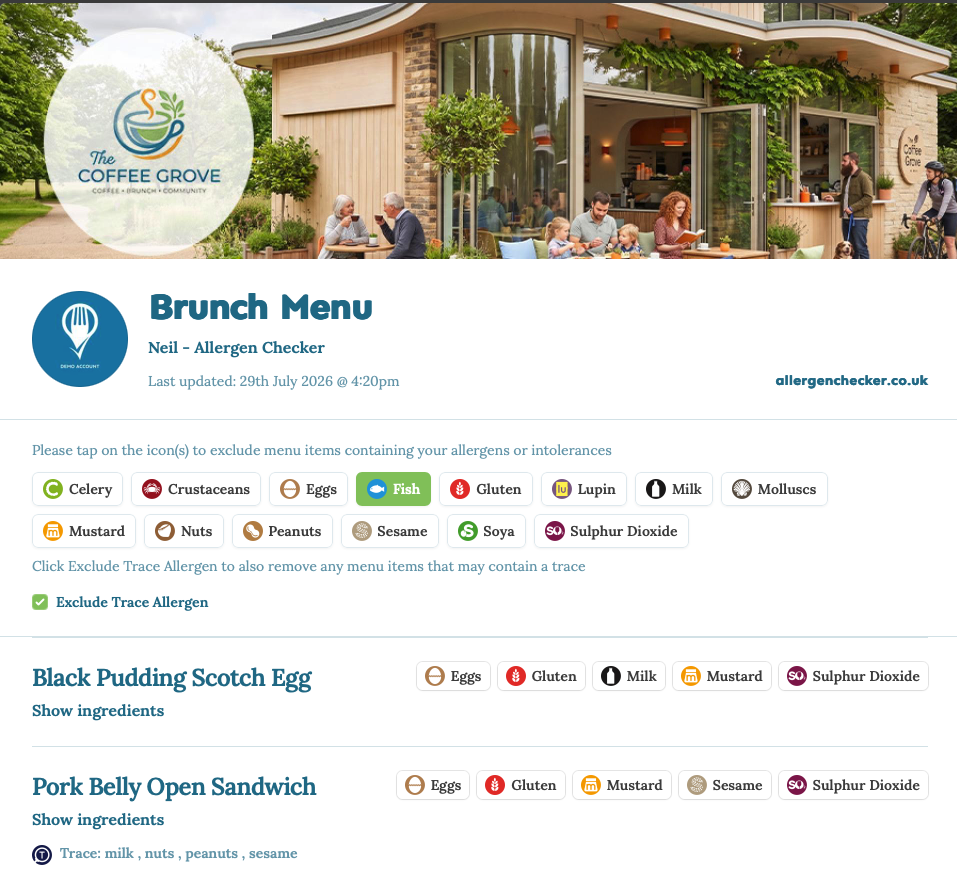 Customers can select the allergens they need to avoid and choose whether dishes carrying trace or “may contain” warnings are also removed.
Try it for yourself - Click here
Ingredients and trace warnings are kept separate
An allergen used as an ingredient is not the same as a precautionary warning that a dish may contain a trace of that allergen.
The new filtering functionality reflects that difference.
Selecting an allergen removes dishes where it has been recorded as an ingredient. Selecting Exclude Trace Allergen also removes dishes carrying a trace or “may contain” warning.
This gives customers greater control over how they view the menu without suggesting that the dishes left on screen are allergen-free.
The filtered menu should be treated as a helpful starting point. Customers should still tell the food business about their allergy so staff can discuss preparation, substitutions and possible cross-contamination risks.
The FSA also makes clear that a free-from claim requires strict controls and is effectively a guarantee that the food is suitable for someone with the relevant allergy or intolerance.
Useful information before the customer orders
Customers should not have to start their dining experience by searching for an allergen folder or trying to find the right person to ask.
An Allergen Checker QR code can be added to printed menus, table displays, menu boards, counters, posters, websites and digital screens.
Customers scan the code, open the relevant menu and identify dishes they may wish to discuss with the team.
They can view the allergen information recorded against individual dishes, reveal further ingredient information and use the new filtering options to narrow down the menu.
This does not replace a conversation with staff. It means that conversation can begin with the customer already having access to useful written information.
Instead of asking, “What can I eat?”, the customer can identify possible choices and then discuss their allergy and the preparation of those dishes with the team.
Supporting current FSA best practice
Food businesses serving non-prepacked food must provide information about the presence of the 14 regulated allergens.
The information can currently be provided in writing, such as on a menu, chalkboard or information pack. It can also be provided verbally, provided there is a clearly visible written notice explaining how customers can obtain it.
However, the FSA’s current advice is that written allergen information supported by a conversation works best for consumers.
Allergen Checker helps food establishments put that approach into practice.
Customers can access written information through the live menu before ordering and without first needing to ask. Staff can then support it with the important conversation about the customer’s individual needs, food preparation and cross-contamination controls.
Allergen Checker is not a replacement for accurate supplier information, staff training, good kitchen procedures or effective allergen management.
It makes the information a business already manages clearer, more accessible and easier to keep together.
Preparing for the direction of Owen’s Law
Owen’s Law is a campaign seeking changes to how allergy information is displayed and communicated in restaurants, following the death of Owen Carey in 2017. The campaign calls for clearer written information and improved communication to help protect people with food allergies when eating out.
Owen’s Law is not currently legislation. However, the direction of travel is clear.
In December 2023, the FSA Board said it would like written allergen information to become mandatory in the non-prepacked sector. The Board also supported an expectation that written information should be accompanied by a verbal conversation between the customer and food-business staff.
Food establishments do not need to wait for a future change in the law before improving how they communicate allergen information.
A live digital menu can help a business:
make written allergen information easier to access
provide information before customers order
reduce reliance on memory or verbal communication alone
create a more consistent process across kitchen and front-of-house teams
manage information across several menus
prepare for possible future changes to allergen requirements
It is a practical step that businesses can take now while also making life easier for the people responsible for managing and communicating allergen information.
Better for customers and catering teams
For customers, the new filtering gives them more control over how they explore a menu.
They can select the allergens relevant to them, choose whether trace warnings should also be excluded and identify dishes they may want to discuss with staff.
For catering teams, the same live menu can support customers with different requirements. There is no need to produce a separate version of the menu for every allergy or intolerance.
When a dish, recipe or ingredient changes, the information can be updated centrally instead of relying on printed matrices or folders that may become outdated.
The aim is not to reduce communication between customers and staff.
It is to create a better-informed conversation supported by clear written information.
See the new menu filter for yourself
Customers can now select the allergens relevant to them, remove dishes containing those allergens and decide whether trace or “may contain” warnings should also be excluded.
Take a look at the live demonstration menu and experience the customer journey for yourself.
Explore the live demonstration menu
Start using Allergen Checker for free
Stay ahead of allergies. Make the smart choice.